



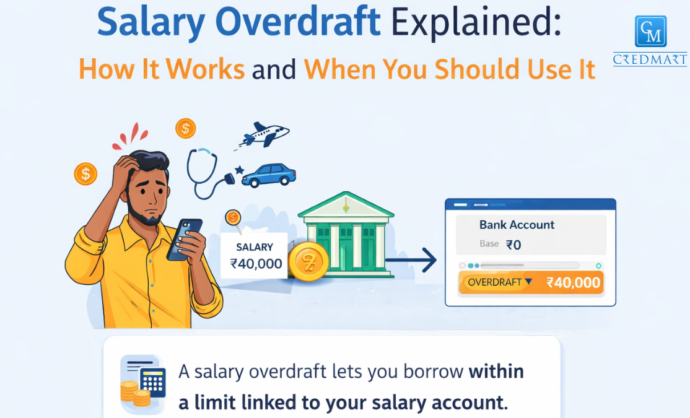
A salary overdraft can be a lifesaver when your expenses don’t match your payday. Imagine your salary is still a few days away and an urgent bill shows up. It’s not poor planning, it’s just bad timing. A salary overdraft helps you handle these short-term cash gaps without applying for a full loan.
That’s exactly the kind of situation a salary overdraft is meant for.
A lot of people have heard the term but are not fully sure what it really means. So let’s talk about it in simple, practical terms.
So what is a salary overdraft?
A salary overdraft is a facility linked to your salary account that lets you withdraw more money than you actually have in your account. The bank gives you a limit based on your income, and you can use that extra amount when you’re short on cash.
You can think of it like a cushion. Your account may be low, but you are not completely stuck. You can still make important payments and handle urgent expenses. Once your salary is credited, the bank adjusts the amount you used.
It is not a full loan in the traditional sense. You are not taking a big lump sum all at once. You just get access to extra funds when needed.
How does it actually work?
Let’s say your monthly salary is ₹45,000. Based on that, your bank may offer you an overdraft limit of ₹70,000 or so.
Now imagine your account balance is almost zero, and you suddenly need ₹6,000 for a medical test. You use that amount from your overdraft. The bank does not charge interest on the full ₹70,000 limit, only on the ₹6,000 you actually used.
When your salary comes in, the used amount is automatically recovered. If you want, you can also deposit money earlier to reduce the interest.
It’s flexible, and that’s the whole point.
Why do people like this facility?
Because it’s there when you need it, without starting a fresh loan process every time.
There’s no waiting period for approval during an emergency. In many cases, the limit is already set. You just use it. That makes it helpful for those in-between days when expenses don’t line up perfectly with your salary date.
It can also save you from borrowing from friends or using your credit card too heavily.
When does using a salary overdraft make sense?
It makes sense in short-term, genuine need situations.
Medical expenses are a big one. Health issues don’t wait for payday. Urgent travel, sudden home repairs, or a vehicle breakdown also fall into this category.
It can also help you avoid late payment charges on important bills if you are just a few days short of funds.
In these cases, the overdraft acts like a temporary bridge until your salary arrives.
When should you avoid using it?
The danger starts when overdraft stops being “occasional help” and becomes “monthly habit.”
Using it for shopping, eating out, gadgets, or trips is not a good idea. That is how people slowly start living on next month’s salary before they even earn it.
If you notice that every month part of your salary is going toward clearing old overdraft dues, it’s a sign that your spending needs a closer look.
Also keep in mind that overdraft interest is usually not cheap. The longer you take to repay, the more it costs.
Salary overdraft vs personal loan
These two are often confused, but they serve different needs.
A salary overdraft is for small, short-term gaps. You use what you need, when you need it, and interest is charged only on that amount.
A personal loan is better when you need a bigger amount and want a clear repayment plan in the form of EMIs spread over months or years.
If the expense will take you a long time to repay, a personal loan is usually more suitable. If you just need help for a short period, an overdraft can do the job.
What should you check before using a salary overdraft?
Before you start using it freely, understand the basic terms.
Find out the interest rate and how it is calculated. Ask if there are any annual or maintenance charges for keeping the overdraft active.
Be clear about how and when repayment happens. In most cases it adjusts automatically when salary is credited, but you should still confirm.
Also ask what happens if your salary is delayed for some reason. Knowing this in advance can save you from surprise penalties.
Final thoughts
A salary overdraft is not free money, but it can be a very useful backup. It gives you breathing room when timing works against you and an expense shows up at the wrong moment.
The key is to use it with discipline. Treat it as a safety net, not an extension of your income. If used carefully and repaid quickly, it can make stressful financial moments a lot easier to handle.
If you are unsure which option is cheaper, read our guide on personal loan vs credit card EMI.
Before using an overdraft, it’s wise to check your CIBIL score and credit report.
Many banks explain salary overdraft features on their official websites.
You can also learn how overdraft interest works from financial guides shared by the Reserve Bank of India (RBI).

How to Increase Your Chances of Home Loan App
Getting a home loan approved can be challenging, but fo...
February 12, 2026

5 Reasons why your CIBIL score is good, but p
If your personal loan is rejected despite having a good...
January 9, 2026


