



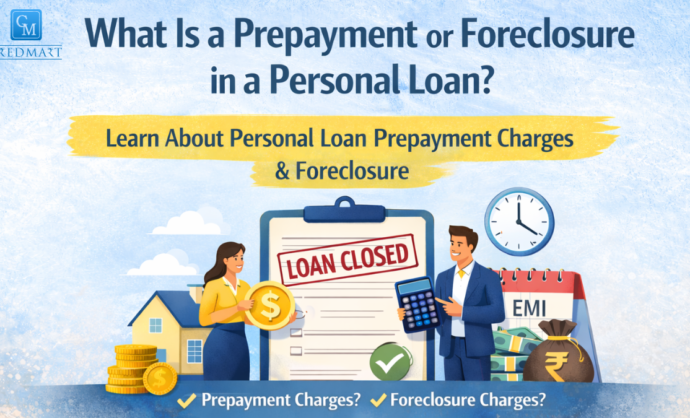
If you already have a personal loan or are planning to take one, you may be wondering about personal loan prepayment charges and whether closing your loan early can actually help you save money. The answer is yes, but there is a catch. Understanding prepayment and foreclosure charges is important before you make that decision.
Personal Loan Prepayment: What Is It?
Paying a portion of your personal loan balance ahead of the loan’s due date or before its term expires is known as prepayment.
Two typical forms of prepayment are as follows:
1. A portion of the payment
In addition to your regular EMI, you make a lump sum payment.
Your remaining loan balance is lowered as a result, which may:
- Reduce your EMIs going forward, or
- Shorten the duration of your loan
2. Complete Prepayment (Foreclosure)
You pay the entire remaining loan amount at once and close the loan completely. This is also called foreclosure of a personal loan
You close the loan entirely after making the final payment in full. Another name for this is personal loan foreclosure
.
What Does a Personal Loan Foreclosure Mean?
Foreclosure entails paying the entire principal amount owed plus any associated fees in order to close your loan early.
Foreclosure is typically chosen when:
- They get a lump sum payment or bonus.
- There are high interest rates.
- They wish to pay off their debt more quickly.
Banks and NBFCs frequently charge a fee for the convenience of foreclosure, even though it lowers interest costs.
What Are Prepayment Fees for Personal Loans?
Lenders charge prepayment fees for personal loans when you pay off your loan early, either in full or in part.
When a loan is closed early, these fees help lenders make up for the interest revenue they lose.
Typical Indian Prepayment Fees
- typically fall between 2% and 5% of the total amount owed on the loan.
- Some lenders impose additional GST charges.
- After a specific number of EMIs are completed, charges may decrease.
Personal Loan Foreclosure Fees
When you close a personal loan entirely before the loan’s term is up, foreclosure fees are applied.
This is how it typically operates:
- Foreclosure is prohibited by many lenders for the first six to twelve months.
- Depending on the lender’s policy, fees only apply if the loan has a fixed or variable interest rate.
- After a lock-in period, some online lenders offer no foreclosure fees.
Prior to making a choice, always review the loan agreement or consult your lender.
When Can You Close a Loan Early with a Bank?
The majority of lenders adhere to these guidelines:
- Foreclosure or prepayment is only permitted following the completion of a certain number of EMIs.
- You might not be able to close the loan early during a lock-in period.
- As the loan matures, fees decrease.
Never assume that the terms are the same because every bank and NBFC has different policies.
Should You Close Your Loan Early?
Closing a loan early sounds great, but it is not always the smartest move. Ask yourself these questions:
It Makes Sense to Close Loan Early If:
-
Prepayment charges are low
-
You are saving a significant amount on interest
-
You already have an emergency fund
-
You want to improve cash flow and reduce monthly stress
Before taking a final decision, it is also helpful to understand how personal loan EMIs are calculated and how interest reduces over time.
Think Twice If:
-
Prepayment charges are high
-
You will drain all your savings
-
Your loan interest rate is already low
-
You could earn better returns by investing the money elsewhere
Sometimes, continuing the loan and investing your surplus money gives better results
.
How to Calculate If Prepayment Is Worth It
Before paying anything extra, calculate:
-
Total remaining interest on your loan
-
Personal loan prepayment charges or foreclosure charges
-
Net savings after paying charges
If interest savings are much higher than the charges, prepayment is usually a good decision.
RBI Guidelines on Personal Loan Foreclosure
As per RBI guidelines:
-
Lenders must clearly disclose prepayment and foreclosure charges
-
Charges cannot be changed arbitrarily after loan disbursal
-
Terms must be mentioned in the loan agreement
This means you have the right to ask for full clarity before taking or closing a loan.According to RBI guidelines, lenders must clearly disclose personal loan prepayment charges and foreclosure fees at the time of loan disbursal.
Tips to Reduce Prepayment or Foreclosure Charges
-
Choose lenders offering zero or low foreclosure charges
-
Prepay after the lock-in period ends
-
Opt for part prepayment instead of full foreclosure if charges are high
-
Negotiate charges, especially if you are a long-term customer
A little planning can save you thousands of rupees.
Final Thoughts
Personal loan prepayment and foreclosure can help you save interest and become debt-free sooner, but only if done wisely. Always factor in personal loan prepayment charges, understand foreclosure charges on personal loans, and calculate your actual savings before you decide to close your loan early.
A loan is not bad. A poorly planned loan decision is.
If you are unsure, take a step back, run the numbers, and then move forward with confidence.

Hidden Charges in Personal Loans You Should K
Personal loans are advertised as fast and easy. Butâ€...
January 7, 2026

Best Loan Services in Noida – A Complete Gu
So finding the best loan services in Noida can help you...
February 18, 2026


