



MSME Loan Interest Rate: What You’ll Actually Pay in 2026
The MSME loan interest rate that the lender gives you is based on the lender you choose and the type of MSME loan you take. Most MSME loans in India have an interest rate between 8 per cent and 18 per cent per year. The government-backed schemes usually have interest rates, while the unsecured loans from NBFCs and fintech lenders have higher interest rates.
This is a range, and the actual interest rate you get depends on a few things. This guide explains what affects the interest rate, what different types of MSME loans usually cost and what you can do to get an interest rate.
Note: The actual interest rates change often and are different for each lender, so you should always check the interest rate with the lender before you apply for the MSME loan. The interest rates mentioned here are estimates and not actual offers from the lenders.
Typical MSME Loan Interest Rate Ranges by Loan Type
Loan products are really different from one another. They have different interest rates. This is because each loan product is a kind of risk for the lender.
Government-backed schemes like CGTMSE, MUDRA, and PMEGP are usually the way to go. The interest rate is often between 8 and 12 per cent. This is because the government is backing the loan. The lender does not have to worry as much about not getting paid back.
If you get a secured term loan, you will have to put up something as collateral. This means the lender can take that thing if you do not pay back the loan. The interest rate for this kind of loan is usually between 9 and 14 per cent.
Machinery loans are a little different. The interest rate is often between 10 and 15 per cent. The machinery you buy is usually the collateral for the loan.
Working capital loans are used to help businesses pay for things. These loans are usually term-based and can be changed easily. The interest rate is generally between 11 and 16 per cent.
Collateral-free loans, or unsecured loans, are the expensive ones. The interest rate is usually between 14 and 18 per cent. This is because the lender is taking a risk by not having any collateral.
These interest rates can change over time. They depend on what the RBI’s doing with their policy rates and what each lender decides to charge. So you should use these rates as a starting point. You should not think they are set in stone.
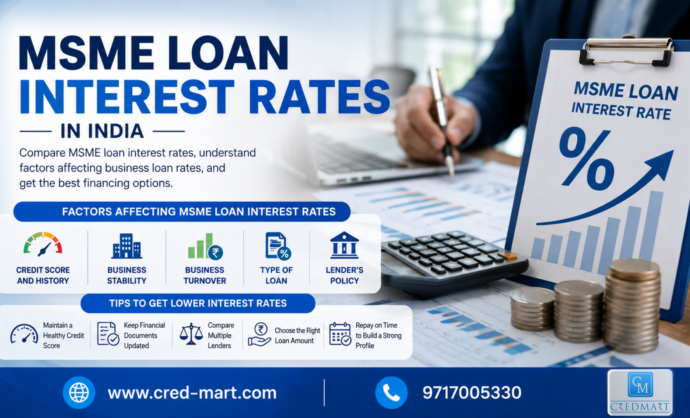
What Actually Determines Your Rate
Credit Score and Repayment History
A credit score above 750 generally qualifies for the better end of a lender’s rate range. Below 650, most lenders either reject the application or quote a rate closer to the top of their range. Missed payments on existing loans or credit cards are one of the fastest ways to push your quoted rate up.
Business Vintage
A business with 3+ years of operating history and consistent filings typically gets a noticeably better rate than a business that’s less than a year old. Newer businesses aren’t locked out — MUDRA and similar schemes exist specifically for this — but the rate tends to be higher to offset the lender’s lack of track record to evaluate.
Annual Turnover and Cash Flow
Lenders look closely at revenue trends, profitability, and existing liabilities. A business with stable or growing turnover and manageable existing debt is seen as lower risk, which directly translates to a better rate offer.
Loan Type and Collateral
As shown above, whether the loan is secured or unsecured is one of the single biggest factors in the rate you’re quoted — often a 4-6 percentage point swing between the two.
Loan Tenure
Shorter tenures sometimes come with slightly lower rates since the lender’s risk window is smaller, though this varies by lender and isn’t a universal rule.
Bank Loans vs NBFC Loans: The Rate Trade-off
Banks generally offer lower interest rates than NBFCs, but with stricter eligibility criteria, more documentation, and slower processing — often 2-4 weeks compared to a few days with some NBFCs or fintech lenders.
NBFCs and digital lenders tend to charge higher rates in exchange for faster approval, more flexible eligibility, and less paperwork. Neither option is universally better — a business that values speed over rate may reasonably choose an NBFC despite the higher cost, while one that can wait and qualifies easily may get a meaningfully better deal from a bank.
How to Get a Lower MSME Loan Interest Rate
A few things genuinely move the needle here:
Maintain a credit score above 750 if possible. This single factor has the largest impact on which end of a lender’s rate range you land in. Paying existing EMIs and credit card bills on time consistently is the most direct way to protect this.
Keep financial documentation clean and current. Updated bank statements, ITRs, and GST filings reduce the lender’s uncertainty, which translates to better offers. Before applying, it’s worth reviewing what documents are typically required so nothing causes delays or weaker offers.
Compare at least 3-4 lenders before committing. Rates can vary by several percentage points between banks, NBFCs, and government-backed schemes for the same loan amount and business profile. A side-by-side comparison, including processing fees, often reveals a meaningfully cheaper option.
Apply for government-backed schemes first if you qualify. CGTMSE-backed loans and MUDRA loans typically offer the lowest starting rates, since the government guarantee reduces lender risk.
Don’t over-borrow. Lenders sometimes price larger loan amounts at slightly higher rates due to increased exposure. Borrowing only what the business genuinely needs can keep both the rate and the EMI burden lower.
Government Schemes Worth Checking First
Before exploring private lenders, it’s worth checking eligibility for these government-backed options, which generally offer the most competitive starting rates:
- CGTMSE — collateral-free loans up to ₹2 crore, backed by a government credit guarantee
- MUDRA Loan — up to ₹10 lakh, aimed at micro and small businesses, including first-time borrowers
- PMEGP — subsidy-linked loans for new manufacturing and service ventures
- SIDBI MSME financing — direct and partner-channel financing for small and medium enterprises
You can see how these compare in our guide to MSME loan schemes in Noida and Delhi NCR.
Frequently Asked Questions
What is a good MSME loan interest rate in 2026? Anything in the 8-12% range is generally considered strong, and typically only available through government-backed schemes or to applicants with excellent credit and financial profiles. Rates above 16% are common for unsecured loans but are worth comparing against secured alternatives if collateral is available.
Does a CIBIL score affect an MSME loan interest rate? Yes, significantly. A CIBIL score above 750 generally qualifies for the lower end of a lender’s rate range, while a score below 650 often results in rejection or a rate near the top of the range.
Are MSME loan interest rates fixed or floating? Both options exist. Fixed rates stay the same for the entire tenure, while floating rates move with the lender’s benchmark rate over time. Floating rates often start lower but carry more uncertainty over a multi-year loan.
Is a collateral-free MSME loan interest rate always higher? Generally yes, since the lender is taking on more risk without an asset to secure the loan against. The difference compared to secured loans is typically 4-6 percentage points, though this varies by lender and scheme.
Which is cheaper — a bank or an NBFC for an MSME loan? Banks typically offer lower rates but have stricter eligibility and slower processing. NBFCs charge more but approve faster with simpler documentation. The better choice depends on whether rate or speed matters more for your situation.
Final Thoughts
The MSME loan interest rate you’re quoted isn’t arbitrary — it reflects your credit profile, business stability, loan type, and whether the loan is secured. Comparing multiple lenders, checking government-backed schemes first, and keeping your documentation and credit score in good shape are the most reliable ways to land closer to the lower end of the range rather than the higher end.
Want to compare real MSME loan interest rate offers for your business? Check your eligibility with Credmart.
The interest rates for MSME loans in India vary depending on several factors, including the lending institution and the borrower’s credit profile. Generally, these rates range from 7% to 12%, reflecting the competitive landscape of financial services aimed at supporting small and medium enterprises. It is essential for potential borrowers to conduct thorough research and compare offerings to obtain the most favorable terms. Additionally, various government schemes may provide subsidies or incentives that can further reduce the effective interest rate for MSME loans.
Useful External Resources

Small Business Loans: Complete Guide for MSME
Small Business Loan: Complete Guide for MSMEs & Sta...
August 6, 2026

What is the CGTMSE Scheme for MSMEs?
Starting and growing a small business often requires fi...
May 20, 2026


