


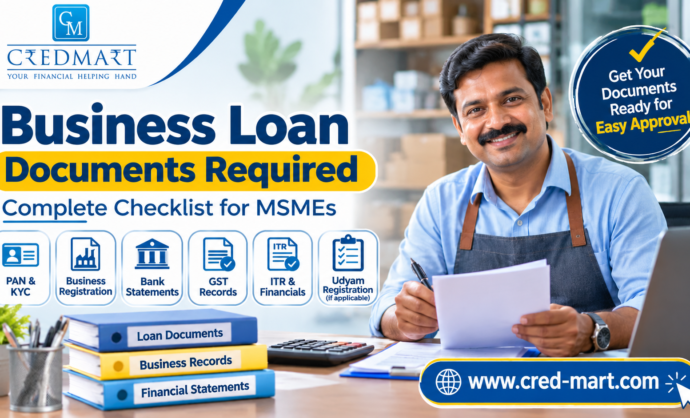
Getting the right documents ready is an important step when applying for business finance. Whether you want to purchase machinery, manage working capital, expand your shop or grow your MSME, lenders generally assess your identity, business details, financial records and repayment capacity.
Understanding the Business Loan Documents Required by different lenders can help applicants prepare their applications more efficiently.
In this guide, CredMart explains the common documents required for a business loan in India, including KYC documents, business registration proof, GST records, bank statements and financial documents.
The documents required can differ depending on the lender, business structure, loan amount and type of financing. However, applicants may commonly be asked for:
| Document category | Common documents |
|---|---|
| Identity proof | PAN card and accepted identity documents |
| Address proof | Residential and business address proof |
| Business proof | Business registration certificate or applicable licence |
| Financial records | Bank statements, ITR and financial statements |
| GST documents | GST registration certificate and applicable returns |
| Additional documents | Loan-specific documents requested by the lender |
The Ministry of MSME’s handbook, Know Your Lender, Grow Your Business, also provides guidance on common documentation for MSME borrowers, including PAN, Aadhaar, Udyam Registration, GST records, ITR, bank statements and financial statements.
Read the official Ministry of MSME lender handbook.
2. KYC Documents Required for a Business Loan
KYC stands for Know Your Customer. Lenders use KYC documents to verify the identity and address of the applicant, proprietor, partners or authorised directors.
Commonly requested documents may include:
- PAN card.
- Aadhaar or another accepted identity document.
- Residential address proof.
- Photograph, where required.
- KYC documents of relevant business owners or authorised persons.
Keep your details consistent across your application and supporting documents.
3. Business Registration Documents for Different Business Types
The business loan documents required for a proprietorship may differ from those requested from a partnership firm or private limited company.
Documents for a proprietorship business
- Proprietor’s PAN and KYC documents.
- Udyam Registration Certificate, if registered.
- GST Registration Certificate, where applicable.
- Shop and Establishment Certificate, where applicable.
- Other accepted business proof.
Documents for a partnership firm
- Partnership deed.
- Firm registration certificate, where applicable.
- PAN card of the firm.
- KYC documents of partners.
- Business address proof.
Documents for LLPs and private limited companies
- Certificate of incorporation.
- LLP agreement or applicable company constitutional documents.
- PAN card of the entity.
- KYC documents of directors or partners.
- Board resolution or authorisation, where required.
If you are exploring MSME financing, you can also read our guide to business loan eligibility for MSMEs.
4. Bank Statements and Financial Documents
Financial statements are an important part of the business loan documents. Required during the lender’s assessment
Commonly requested financial documents include:
- Business bank statements for the period specified by the lender.
- Income Tax Returns (ITR).
- Profit and Loss Statement.
- Balance Sheet.
- Cash flow statements, where applicable.
- Audited financial statements, if required.
The Ministry of MSME handbook discusses bank statements, income tax returns and financial statements as common documentation for MSME borrowers.
Make sure the financial information submitted is accurate and consistent.

5. GST Documents Required for a Business Loan
GST records may also form part of the Business Loan Documents Required, depending on the applicant’s business and lender policy
Depending on the lender and applicant, these may include:
- GST Registration Certificate.
- Applicable GST returns.
- GST-related business details.
- Other tax records requested by the lender.
If your business is not required to register under GST, ask the lender which alternative documents may be accepted.
You can refer to the official GST Portal for GST-related services and information.
6. Udyam Registration and MSME Business Loan Documents
Udyam Registration is an important business registration for eligible micro, small and medium enterprises. Depending on the loan product, lenders may request the Udyam Registration Certificate as part of the application.
You can check official MSME information and registration services through:
If you are exploring government-supported financing options, read our article on MSME Loan Schemes in Noida and Delhi NCR.
Businesses in the region can also explore our information about MSME Loans in Delhi.
7. Documents Required for Different Types of Business Loans
The business loan documents required can also depend on the purpose of financing.
Working Capital Loan
For working capital financing, lenders may request:
- Bank statements.
- GST returns, where applicable.
- Financial statements.
- Business details.
- Details of existing credit facilities, where applicable.
If your business operates in or around Noida, you can explore our MSME Working Capital Loan in Noida page.
Machinery Loan
For machinery financing, lenders may ask for:
- Machinery quotation.
- Supplier details.
- Proforma invoice or purchase estimate.
- Business financial records.
- Standard KYC and business documents.
Business Expansion Loan
For business expansion, lenders may request:
- Business financial statements.
- Bank statements.
- Business plan or expansion details.
- Projected cash flows, where applicable.
- Details of the proposed investment.
Loan Against Property for Business
For a secured loan against property, lenders may ask for property ownership documents, title-related records, valuation and legal documents in addition to standard KYC and financial records.
8. Documents Required for Small Business and Mudra Loans
Keeping the Business Loan Documents Required organised before applying can make the application process smoother.
For example, applicants exploring a MUDRA loan may be asked for identity, business and financial documents according to the lending institution’s requirements.
The official Ministry of MSME FAQ explains that documentation requirements for MUDRA loans are governed by the lending institution’s terms and conditions.
You can also explore our guide to Mudra Loans for Small Businesses.
Keep the following documents organised before making an enquiry:
- PAN and KYC documents.
- Business registration or accepted business proof.
- Bank statements.
- Available ITR and financial records.
- GST registration and applicable returns.
- Udyam Registration Certificate, if available.
- Loan purpose and estimated funding requirement.
Having these documents ready can make the application process more organised. It does not guarantee loan approval.
9. Business Loan vs Personal Loan: Are the Documents Different?
Yes. Business loans and personal loans have different application requirements because lenders assess different aspects of the applicant’s financial profile.
For a business loan, lenders may review business registration, business bank statements, turnover and financial statements.
For a personal loan, lenders generally assess personal income, employment details, credit profile and repayment capacity.
If you are looking for personal financing, you can explore Personal Loan options through CredMart.
10. Common Documentation Mistakes to Avoid
Before submitting your application, check for these common mistakes:
- Name or address differences across documents.
- Incomplete bank statements.
- Outdated business registration details.
- Missing or inconsistent financial records.
- Incorrect or incomplete GST information.
- Unclear machinery quotations or supplier invoices.
- Unreadable or incomplete document copies.
- Not providing additional information requested by the lender.
Review your application carefully and provide genuine and accurate information.
11. How to Apply for a Business Loan Through CredMart
CredMart Services Pvt. Ltd. helps business owners explore financing options through its network of banks and NBFCs.
Here is how you can get started:
- Visit the CredMart website.
- Submit your business loan enquiry.
- Share your business details and funding requirements.
- Discuss the applicable documentation requirements.
- Explore available lender options based on your profile.
- Complete the application process with the selected lender.
If you are planning to expand your business, manage working capital or purchase machinery, you can explore the available Business Loan options through CredMart.
The eligibility, interest rate, loan amount, repayment tenure, collateral requirements and approval decision depend on the selected lender’s policies and applicant profile.
Looking for business loan options?
Connect with CredMart to understand your business financing requirements and explore available options.
Visit: https://cred-mart.com/
CredMart — Your Financial Helping Hand.
12. Frequently Asked Questions
What are the basic documents required for a business loan?
Common documents include PAN, KYC documents, business proof, bank statements and applicable financial and GST records. The final list depends on the lender and loan product.
Can I apply for a business loan without GST registration?
Some lenders may consider businesses that are not GST-registered, depending on the nature of the business and applicable registration requirements. Alternative business and financial documents may be requested.
Is Udyam Registration mandatory for a business loan?
Udyam Registration is not a universal requirement for every business loan. However, lenders may request it for certain MSME-focused products or schemes.
How many months of bank statements are required?
The required statement period varies by lender and loan product. Check the specific lender’s documentation checklist before applying.
Are documents different for proprietorship and private limited companies?
Yes. A proprietorship may need individual proprietor KYC and accepted business proof, while a private limited company may need incorporation documents, company PAN and authorised signatory details.
Does submitting all documents guarantee business loan approval?
No. Complete documentation helps the lender evaluate an application, but approval depends on the applicant’s credit profile, business financials, repayment capacity and lender policy.
Disclaimer: Documentation requirements differ between banks, NBFCs and loan products. This article provides general information and should not be treated as a guarantee of loan eligibility or approval. Always verify the latest requirements with the selected lender.

Business Loan in Noida | Fast Approval &
Looking for a business loan in Noida? Whether you want ...
March 14, 2026

Best Government Loan Schemes for Small Busine
Government loan schemes for business in India are desig...
April 9, 2026

